// op_008 — case study In Dev
CyberLab Mobile
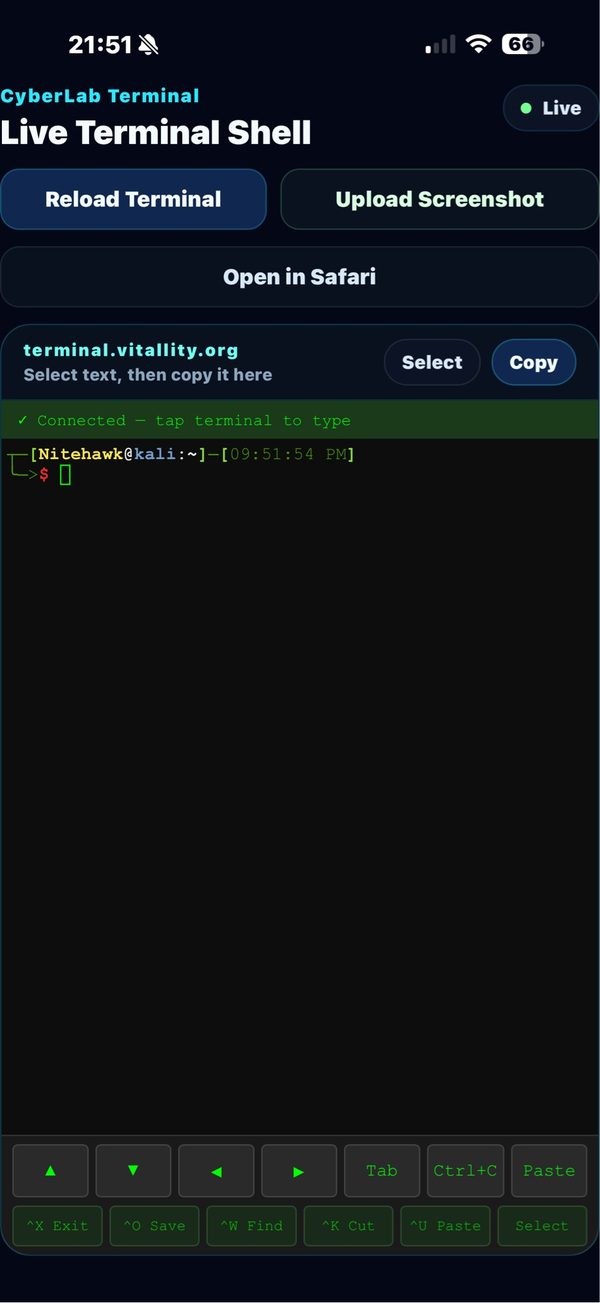
// the problem
Running a personal pentesting lab usually means SSHing into a Kali box from whatever terminal app is closest, manually tracking which scans ran against which target, and copy-pasting tool output into a report by hand. There was no single mobile surface for managing targets, running scans, and reviewing results — without putting offensive tooling directly on the phone.
// architecture decisions
Isolation Model
The device never runs tools directly — it connects over HTTPS + JWT to a private Kali/Ubuntu server where every approved tool executes inside an isolated Docker container, with per-target authorization enforced server-side.
Job Queue
A Python Celery worker queue manages the Docker-isolated scanner containers — nmap, masscan, Nuclei, Nikto, OWASP ZAP, testssl.sh, Amass, Subfinder, theHarvester, WhatWeb, Gobuster, dig, whois, arp-scan — so long-running scans never block the API.
Native UI
Swift/SwiftUI with SwiftData for offline caching gives the app native performance for network topology mapping rendered on SwiftUI Canvas, plus WidgetKit and iOS Shortcuts integration that a cross-platform framework couldn't match here.
Backend
Node.js/TypeScript Express on Railway with PostgreSQL, Drizzle ORM, Redis, and Zod validation — a typed contract from API boundary to database, with Redis decoupling job status from the request/response cycle.
// by the numbers
14
Build Phases
13
Phases Complete
14+
Integrated Scanner Tools
// key outcomes
A context-aware AI assistant powered by Claude helps interpret scan results in plain language, while NVD and CISA KEV enrichment adds real vulnerability intelligence to raw findings. Multi-page PDF report generation, scan diffing, and a CVSS v3.1 calculator turn a phone into a legitimate lab command center — Face ID-gated, fully audited, and currently in Phase 14 of 14.
// have an app to harden?
Security-sensitive mobile products need more than a working screen. If you are preparing an app, API, or backend for real users, the Application Security Snapshot maps the highest-risk paths before launch.
// related builds