Nobody commissioned this. In May 2026 the EDD rebuilt its unemployment certification
experience — 45 screens and more than 1,740 lines of content reviewed to strip out language
that confused customers. That is the standard the department has already set for itself.
Paid Family Leave has not had the same treatment, and it is the harder problem: the claimant is
a new parent or a caregiver, often sleep-deprived, usually on a phone, and the process depends on
documents that two other people — a care recipient and a physician — must sign and
return inside a 41-day window the claimant cannot extend.
So I audited it the way I would audit a client's product, against the public site as it stood on
12 September 2026, and published the evidence with it.
// op_014 — case study UX Audit
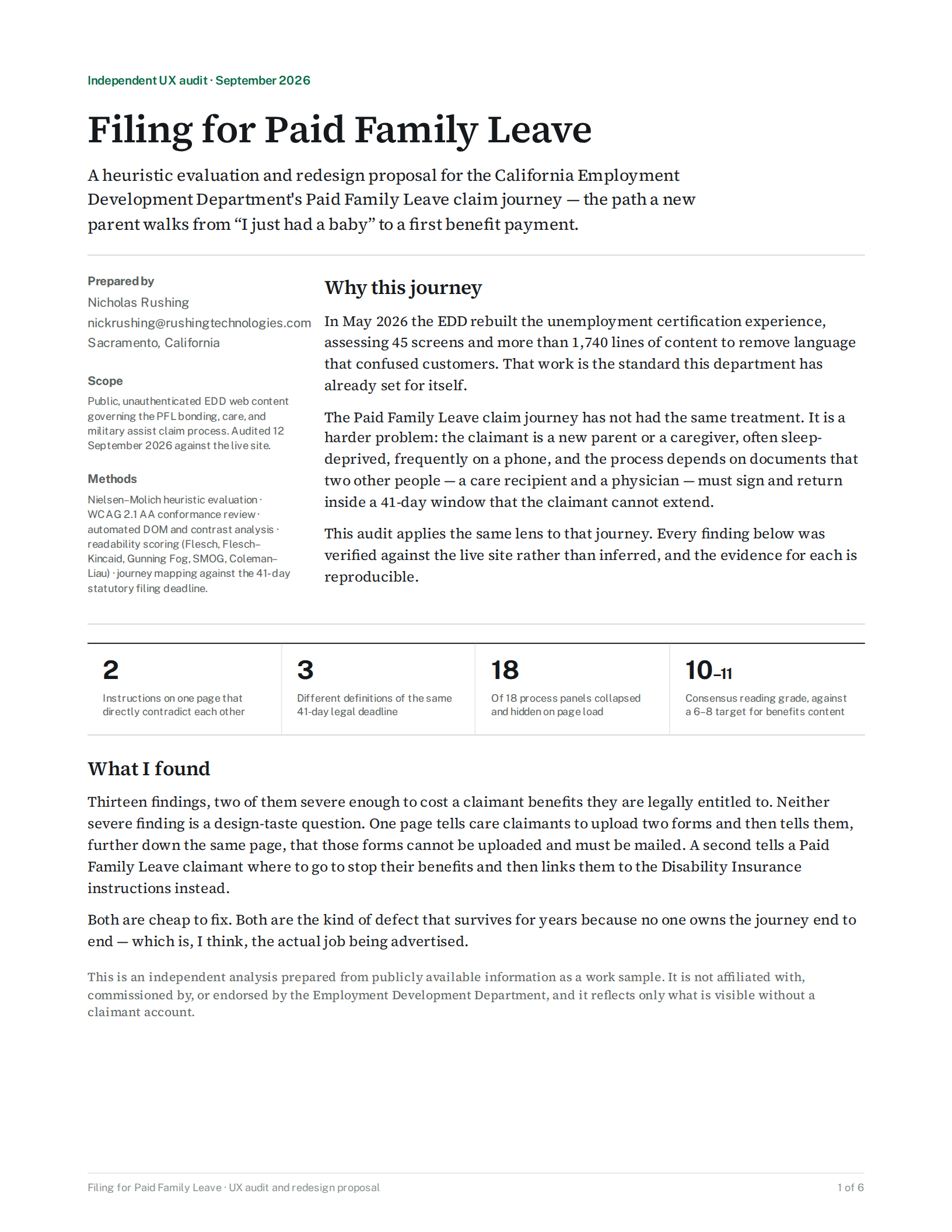
EDD Paid Family Leave
An independent UX audit and redesign proposal for the California Employment Development
Department's Paid Family Leave claim journey — the path a new parent walks from
“I just had a baby” to a first benefit payment. Thirteen findings, every one of them
verified against the live site rather than asserted. Two are severe enough to cost a claimant
benefits they are legally entitled to.
// the brief
// by the numbers
13
Findings — 2 critical
41
Day statutory filing window
18/18
Process panels collapsed on load
10–11
Reading grade vs. 6–8 target
// the problem
California law gives a claimant 41 days from the start of family leave to file. The clock runs
continuously, nothing in the journey pauses it, and almost nothing in the middle of it is under
the claimant's control. The application itself is competent — a claimant who reaches SDI
Online and completes sections one through five has done the part the department designed well.
Every failure mode sits in the handoffs either side of it.
DAY 0 DAY 10 DAY 19 DAY 29 DAY 41
o--------------o---------------o---------------*---------------*
| | | | |
leave paper form care recipient physician deadline
starts arrives signs Part C signs Part D benefits lost
[claimant] [---- waiting on two other people, no status ---]
o claimant can act * no status is exposed to the claimant
// three parties, one deadline, one of them can see it
| The claimant | The care recipient | The physician | |
|---|---|---|---|
| Must act before day 41 | Yes | Yes | Yes |
| Is shown the deadline | Must calculate it | No | No |
| Receives a reminder | No | No | No |
| Can see the claim's status | No | No | Can search for it |
| Bears the loss if it slips | Entirely | Nothing | Nothing |
The asymmetry is the design problem. The only participant with anything at stake has the least
information and no way to intervene. A claimant who misses the window does not lose a form
submission — they lose wage replacement during the weeks they are least able to absorb it,
and the denial arrives with a 30-day appeal attached, converting a content defect into appeals
workload.
// the two findings that carry the audit
Neither is a design-taste question. Both are objectively verifiable from the public page, which
is what separates them from an opinion about a website.
01Critical
One page gives care claimants two opposite instructions for submitting their medical certification
Step 2 tells the claimant to upload Parts C and D to their SDI Online claim or mail the completed forms. Step 3 of the same page states those parts can't be uploaded currently and must be mailed. A claimant who follows the first instruction believes the claim is complete and learns otherwise only when it stalls — by which point the 41-day window may have closed.
Verified — both strings present in the rendered DOM of the PFL claim process page, one occurrence each.
Fix — render channel rules from one content object and show only the path for the claimant's claim type. Until the uploader supports these parts, the control should not be reachable. An instruction not to use a visible control is a design failure, not a content one.
02Critical
A link labelled for Paid Family Leave sends the claimant to Disability Insurance instructions
The final step links to “Paid Family Leave — Stop or Continue Your Benefits.” The destination is the Disability Insurance page. A correct PFL page exists and is live at the parallel address, so this is a wiring error rather than missing content — and a claimant ending a bonding claim receives the rules for a different programme.
Verified — the link resolves to the DI discontinue/continue page. Both the DI and PFL pages return HTTP 200 with distinct titles.
Fix — correct the reference, then add automated link-integrity and label-destination checking to the content release pipeline so the class of defect cannot recur silently. A twenty-minute fix and a one-sprint prevention.
// the rest of the ledger
Severity reflects consequence to the claimant, not effort to fix.
03Serious
The same statutory deadline is defined three different ways
One page says 41 days after family leave starts and, for mothers transitioning from a pregnancy-related disability claim, 41 days from the date they wish to begin bonding. The published fact sheet renders it a third way. These are not equivalent, and the claimant is the one who must compute the date.
04Serious
The recommended online path is not online
Filing a care claim “online” requires ordering a printed form through the mail, collecting two wet signatures, and mailing it back — inside 41 days, with EDD's own guidance allowing up to ten days for the form to arrive. The department already operates an electronic certification route for physicians, so the capability exists. It is simply not offered at the moment the claimant needs it.
05Serious
Accepted upload formats exclude the format most phones produce
Claimants are told to scan and save documents as PDF, JPG, TIF, or TIFF. The required proof of relationship is usually a birth certificate, which a new parent photographs on a phone, and current iPhones capture HEIC by default. “Scan” presumes a scanner, and the claimants least likely to own one are the ones this programme exists to reach.
Flagged for verification — this reads the published instruction, which is public. The authenticated uploader may already accept more than the page lists, so the audit records it as needing confirmation rather than confirmed.
06Serious
Nothing reports the state of the claim back to the claimant
The claimant waits up to 14 days with no view of whether documents arrived, whether the physician returned Part D, or what is outstanding. Visibility of system status is the first heuristic because its absence generates the contact volume everything downstream absorbs.
07Moderate
Every step of the process is hidden on page load
All eighteen expandable panels render collapsed. A claimant arriving to find out how to apply sees five headings and no content, cannot scan the process, and in most browsers cannot reach the text with find-in-page.
Verified — 18 of 18 elements carrying aria-expanded are set to false in the delivered markup.
08Moderate
Heading structure skips a level, breaking the outline for screen reader users
The document moves from the page title straight to third-level headings. The five process steps have no parent heading, so navigating by heading level yields a structure that does not match the visible one. WCAG 2.1 §1.3.1, Level A.
Verified — one heading-level skip, h1 to h3, across 20 headings.
09Moderate
The embedded chat frame has no accessible name
The page's single iframe carries no title attribute, so assistive technology announces an unlabelled frame inside the help region. WCAG 2.1 §4.1.2, Level A.
Verified — 1 iframe, 0 with a title attribute.
10Moderate
Form codes and part letters are the primary names for things
Seven document codes appear on this page alone, and the form divides into lettered parts that are sequential for no one: bonding needs A and B, care needs A, C and D, military assist needs A and E. Every claimant receives the same eleven-page document and assembles their own subset. Two EDD pages disagree about which page Part E is on.
11Moderate
Reading level sits above the target for public benefits content
Measured across 1,122 words: Flesch Reading Ease 61.3, Flesch–Kincaid 8.3, Gunning Fog 10.9, SMOG 11.4, Coleman–Liau 9.6, consensus grade 10–11. The prose is not badly written — sentences average 14.6 words. The grade is driven by undefined vocabulary: “base period” appears four times on a page that never defines it. The gain here is vocabulary, not sentence surgery.
12Moderate
Same-sex non-birth parents are instructed to select “Other”
The relationship field has no value describing this family, so guidance on a separate page asks the claimant to work around it — content doing repair work for a data model, and only for claimants who read that page first.
13Low
A duplicated item in the proof-of-relationship list
The foster care agency letter appears twice, once appended to an unrelated bullet. Trivial alone, but a signal that this list is maintained by hand without review.
// what already works
An audit that finds only faults is not useful, and the automated checks found the underlying
hygiene sound — which is what makes the failures above worth fixing rather than symptoms of a
page needing replacement. These should be protected in any redesign.
The best line on the page
“If you are unsure if you are eligible, apply.” One sentence that removes self-screening, a leading cause of under-take-up.
Stated plainly, early
Citizenship and immigration status do not affect eligibility — unhedged, and near the top. Foster and adoptive parents are first-class claimants, not an appended exception.
| Automated check | Result |
|---|---|
| EDD green on white | 6.57:1 — passes WCAG AA (4.5:1) |
| Links with an accessible name | 228 of 228 |
| Heading level skips | 1 — finding 08 |
| Frames with a title | 0 of 1 — finding 09 |
// proposed design
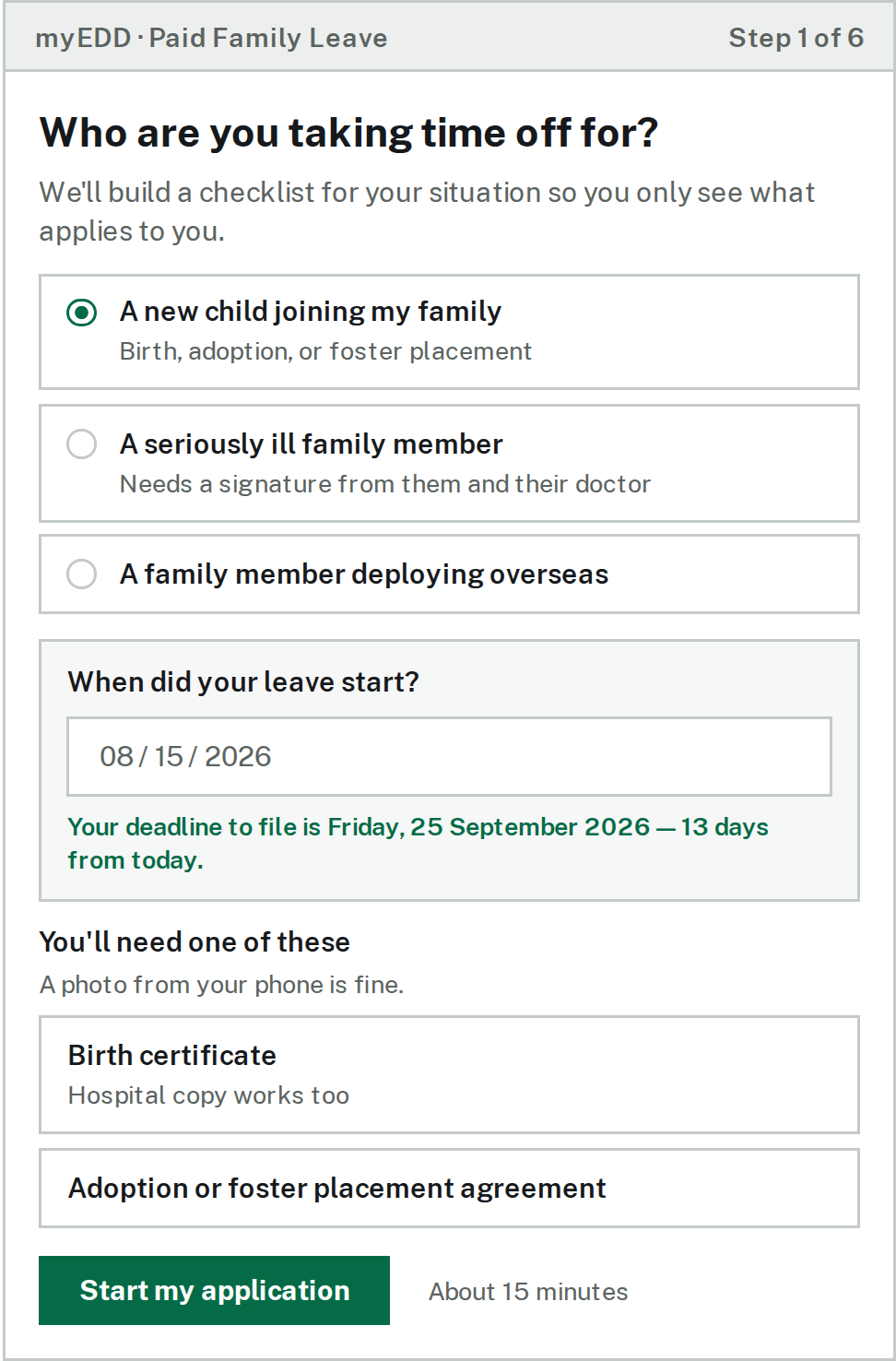
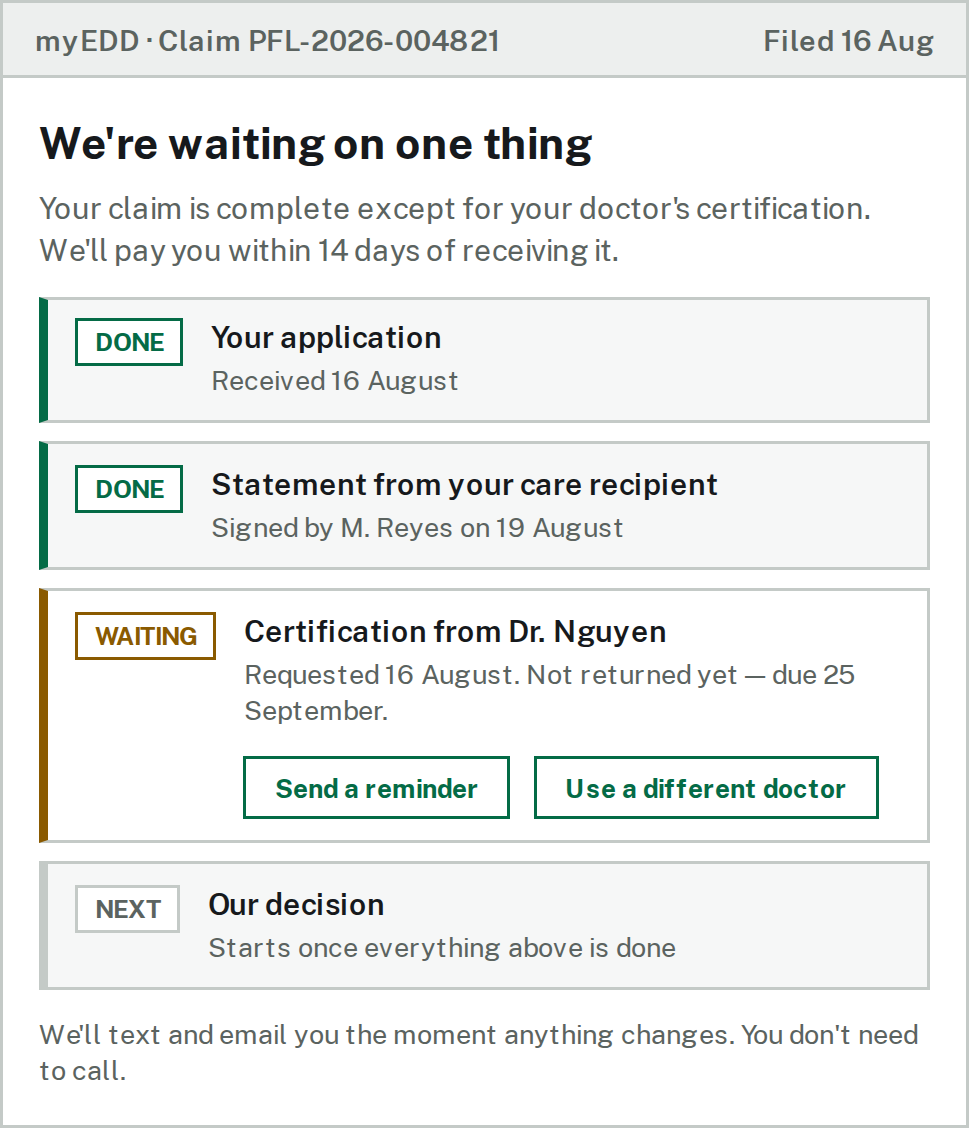
Two screens address eight of the thirteen findings, and neither requires replacing SDI Online.
The first moves the deadline, the documents, and the dependency on other people to the front.
The second gives all three parties a shared view of where the claim stands.
// three rules i would hold a redesign to
Compute it, don't ask for it
Never make the claimant work out something the system already knows. Dates, deadlines, and required documents are all derivable from the claim type and the start date.
Show the dependency to whoever bears it
The claimant loses the benefit when a third party is late, so the claimant sees that party's status and has a way to act on it.
Fix the flow, not the sentence
Several findings here have been patched with warning copy where the underlying process should have changed. A warning that a visible control will break your claim is not a fix.
And one rule about the audit itself
A heuristic evaluation finds candidate problems cheaply. It is not evidence that they are the most important ones. Before building anything, size it from data the department already holds — incomplete-submission rates by claim type, days from leave start to first payment, contact volume by reason code, upload rejection rate by file extension.
// how i would validate it
Three things, in order, before a line of production code. One, size the findings against
the department's own operational data so the baseline is measured rather than asserted.
Two, moderated usability testing — six to eight participants per claim type, recruited
to include mobile-only users, Spanish speakers, and recent filers, each filing a care claim end to
end. I would watch specifically whether anyone notices the contradictory upload instruction, and
how they compute the 41-day date unaided. Three, assistive technology testing with NVDA,
JAWS, and VoiceOver, with participants who use them daily. Tooling caught findings 08 and 09; it
will not catch whether the accordion is usable with a screen reader, whether status changes are
announced, or whether the flow survives at 200% zoom.
// method and limits
Nielsen–Molich heuristic evaluation, WCAG 2.1 AA conformance review, automated DOM and
contrast analysis, readability scoring across five formulas, and journey mapping against the
41-day statutory deadline. What the analysis cannot support matters as much as what it found:
Public content only. No claimant account, no authorised access. The SDI Online application screens, the uploader, and the notices are outside the review. Where a finding depends on system behaviour rather than published instruction — finding 05 especially — the document says so rather than asserting it.
No users were observed. Every severity rating is a judgement about likely consequence, not a measured rate. Heuristic evaluation over-weights what is visible and under-weights what is merely common.
Readability formulas are blunt. They score syllables and sentence length, not comprehension. Five are reported because they disagree, and the disagreement is itself informative.
A point in time. Findings reflect the site as of 12 September 2026 and may already be resolved.
// why i did this
My background is not a conventional design one. I have spent a decade as a California correctional
officer, most recently running the daily appointment and scheduling process for the mental health
programme at Mule Creek State Prison — a workflow whose users cannot opt out, where an error
means someone misses care, and where the people it serves had no hand in designing it. I hold a
bachelor's degree in information technology, finish a master's in IT management this December, and
build and ship software.
What I take from that is the habit of reading a process from the position of the person it happens to. This audit is that habit applied to a system I do not work on.
What I take from that is the habit of reading a process from the position of the person it happens to. This audit is that habit applied to a system I do not work on.
// artifacts
The full six-page document, the two wireframes at 3x, and the analysis scripts that produced the
readability and accessibility numbers. The scripts are published rather than available on request
— every number on this page is reproducible from the public page.
This is an independent analysis prepared from publicly available information as a work sample. It
is not affiliated with, commissioned by, or endorsed by the Employment Development Department, and
it reflects only what is visible without a claimant account. Sources: edd.ca.gov PFL claim process,
PFL filing guidance, and DE 8714CF, retrieved 12 September 2026.
// related builds